Before the Money Arrives: How Korea, Vietnam, and the Philippines Rebuilt for the Index
Index inclusion draws a largely mechanical bid from passive money. A market has to rebuild its settlement, currency access, or pricing to earn the weight, and Korea, Vietnam, and the Philippines are each doing that across 2026.
A rulebook the money follows
A benchmark index is a rulebook, and much of the money that follows it has limited discretion. A fund built to replicate an index holds what the index holds, close to the weight the index assigns, within the tracking-error budget its mandate allows. When an index provider admits a market, replicating portfolios face pressure to buy, and a large share of that buying is mechanical, driven by the weight more than by the price. Admission turns an editorial decision at an index committee into a bid for a sovereign's bonds or shares. The bid is real, and it is conditional: the provider sets the terms of entry, and a market has to meet them before much of the money moves.
The bid, and its limits
The demand has edges worth marking. Capital that passively tracks an index buys constituents in proportion to their weight and holds them while the weight persists, and that demand is relatively price-insensitive on the way in, because the mandate is to match the benchmark rather than to judge value. The largest bond indices, though, are sampled rather than fully replicated, and active managers who benchmark to the same index keep more room to choose. Much of the price adjustment also tends to happen in anticipation, as investors position ahead of the flows they expect. What the rulebook sets in motion is the pressure, and the timing is looser.
Korea enters the developed tier
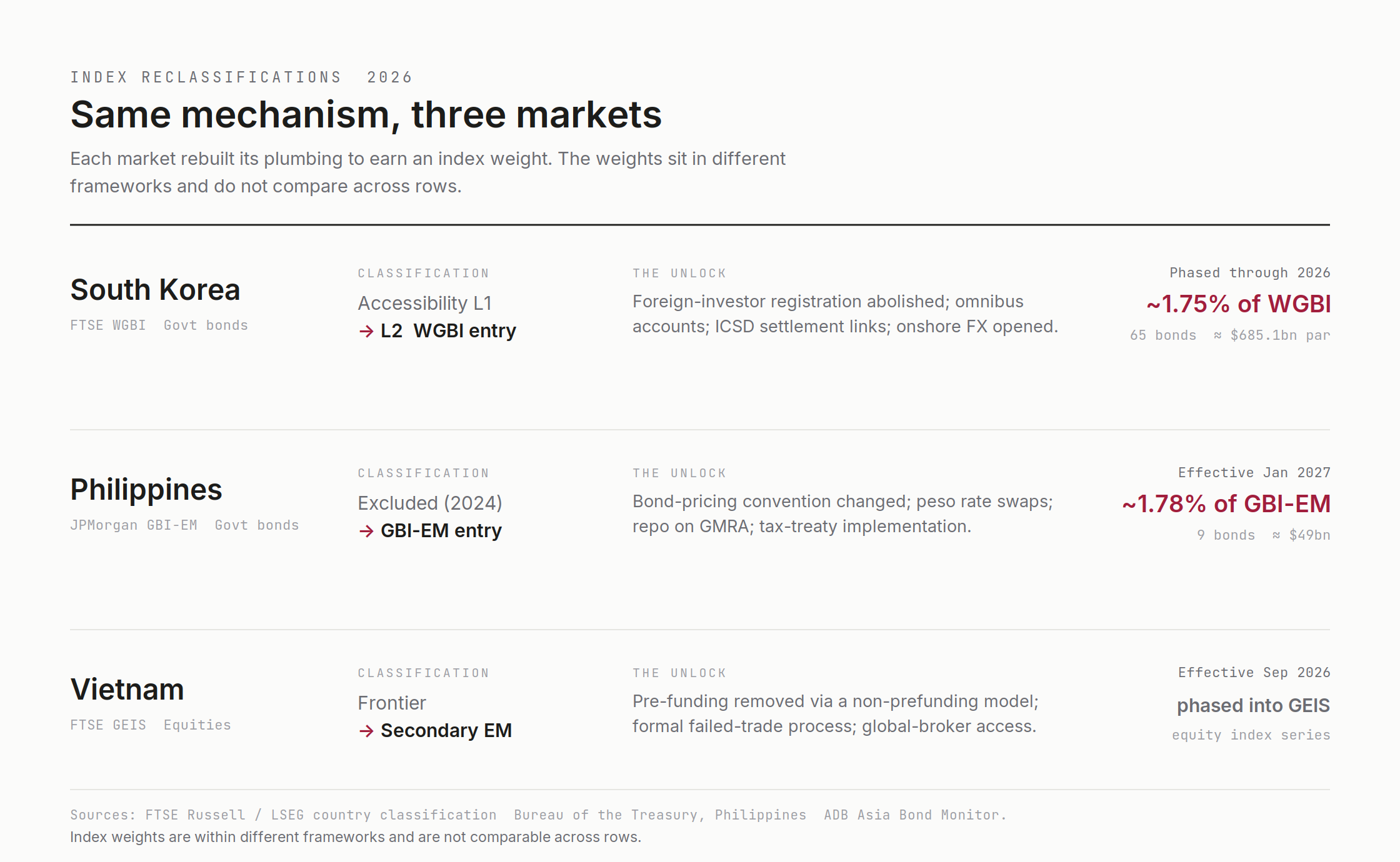
South Korea is the clearest case. FTSE Russell is admitting Korean government bonds to the World Government Bond Index, where they reach about 1.75 percent once fully phased in, a set of sixty-five won-denominated government bonds carrying roughly $685.1 billion in par amount outstanding, by FTSE Russell's country classification. Inclusion is staged across monthly tranches through 2026 rather than delivered at once, and the index's pricing source for these bonds moves to a local vendor quote taken at the Tokyo close. Official estimates of the associated inflows have run into the tens of billions of dollars. The estimate can move; the weight and the eligible universe are set by rule.
The work that comes first
That bid is the reward for work done earlier. An index provider generally does not admit a market until it clears the provider's accessibility standards, and clearing them means rebuilding the infrastructure that foreign institutions touch. Korea's upgrade followed a decades-old foreign-investor registration system being abolished, omnibus account structures opened so global managers can trade and settle under their own names, settlement links built to the international central securities depositories, and the onshore currency market extended and opened so offshore institutions can fund and hedge won positions. Little of this shows up in a yield, and without it the weight would not exist.
Vietnam clears a lower bar
Vietnam shows the same conditionality one rung down. FTSE Russell is reclassifying it from frontier to secondary emerging market status, effective from the September 2026 semi-annual review, and the confirmation cited specific plumbing: the requirement that foreign investors pre-fund trades removed through a non-prefunding model, a formal process for handling failed trades, and improved access for the global brokers that index replication depends on. The same review cycle that cleared Vietnam also moved Greece from advanced emerging to developed status and added Slovakia to the government-bond index, a reminder that one provider's decision reclassifies several markets at once.
The Philippines, and the cost to incumbents
The Philippines fills in the part the enthusiasm around inflows tends to skip: the reforms that unlock the flow are not free to the investors already holding the paper. JPMorgan is adding Philippine peso government bonds to its emerging-market government bond index, effective January 2027, after Philippine peso debt was dropped from the index in 2024 for illiquidity. The eligible set is nine bonds worth about $49 billion, for a projected weight near 1.78 percent, and the qualifying reforms run from tax-treaty implementation and a new peso interest-rate-swap market to a repo market rebuilt on standard master documentation.
A change that moves the marks
One of the later items is a change in the convention by which government bonds are priced. Against a local-currency government bond stock of roughly 14.1 trillion pesos, about $230 billion by the Asian Development Bank's measure, a change in pricing convention alters how existing securities are marked. Holders who carry their bonds to maturity see the same contractual cash flows; holders who sell into the new convention may find the marks have moved. The entry ticket can carry a cost for incumbents, and it is borne at home.
A weight is not a dollar figure
Set the three side by side and two features come forward. The first is that a weight is not the same as a dollar figure. Korea's 1.75 percent of the world government bond index and the Philippines' 1.78 percent of the emerging-market index are almost the same number, yet the capital each can draw need not be similar, because the dollar demand behind a weight depends on how much money tracks that particular index. Far more capital is benchmarked to the large developed-market government bond index than to the emerging-market one, so the size of the bid depends as much on the company a market joins as on the market itself.
Standards set outside the market
The second feature is symmetry. The relative price-insensitivity that supports a market on entry can run the other way on exclusion, when index-tracking portfolios reduce toward a lower weight with similar indifference to price, and the Philippines' own removal in 2024 is the near example. Seen this way, an index provider's standards work much like a standard set outside the sovereign that answers to them: a market reorganises its settlement, its currency access, and its pricing to satisfy criteria it does not write, in exchange for a flow it does not fully control. Whether that arrangement steadies a market or leaves it more exposed to the next reclassification is a question worth holding open.