China's Humanoid Robots Reach the Public Market
In 2026 a Chinese humanoid-robot maker listed in Shanghai, and the industry gained a financial language: valuation, margin, and the cost of an hour of useful work. The demonstrations show what the machines can do; the accounts show what they are worth.
From the stage to the exchange
At the 2025 Spring Festival gala, a line of Unitree H1 robots danced beside human performers, and the clip travelled widely. About eighteen months later, in August 2026, Unitree listed on the STAR Market of the Shanghai Stock Exchange. A company that had reached a national television stage now had to answer to a public order book. The move frames three questions worth following in order: how humanoid robots reached this point, how different companies chose different routes, and when the industry can begin to return capital rather than only absorb it.
Three questions, in order
The public tends to meet humanoid robots through dancing, running and backflips, which show fast progress in physical capability. Commercialisation asks a different set of questions. Can the same task be repeated reliably, can the machine work safely, how often does it fail, what does maintenance cost, and what does each productive hour cost. The industry has moved through that sequence: first whether the machine can move, then whether it can work, and finally whether it can earn an acceptable return on the capital it ties up. Each question is harder to answer than the one before it.
Decades behind the demonstrations
The demonstrations sit on a long base. Chinese universities and research institutes were studying bipedal walking, balance and coordinated control in the 1990s. The focus moved from research toward products in the following decades: UBTECH was founded in 2012, and Unitree in 2016, entering first through four-legged robots. Around 2023, large models and embodied intelligence added a further layer, and lower prices, pilot deployments and public demonstrations accelerated together. By 2026 the accumulated research was turning into an industry, and that industry was beginning to face the discipline of public disclosure.
Two paths to the same test
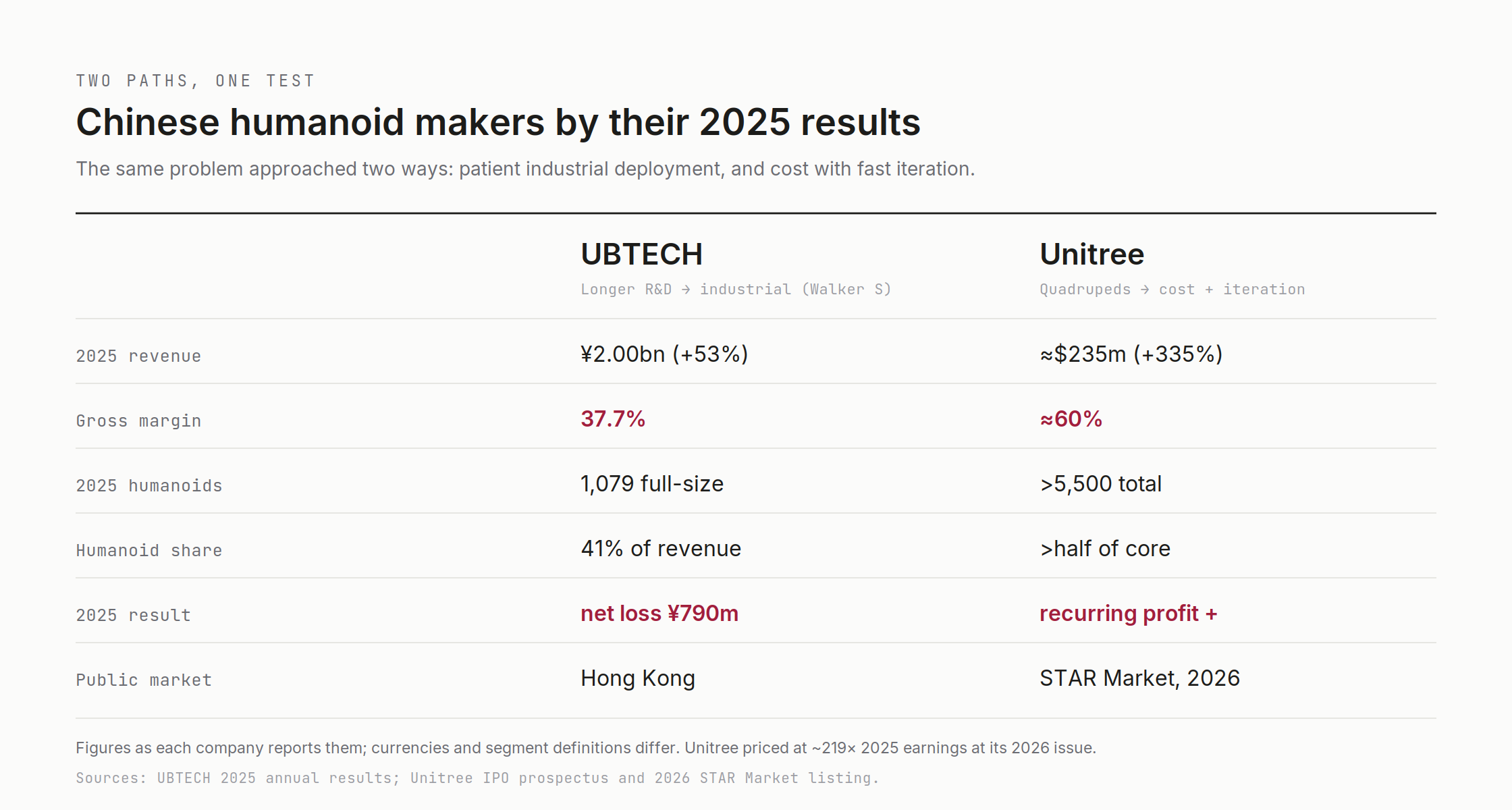
Two listed makers show how differently the same problem can be approached. UBTECH took the longer, industrial route: by its 2025 annual results it had delivered 1,079 full-size embodied humanoids, the first company to pass a thousand in that segment in a year, and that business became its largest revenue line at about 41 percent of the total. Unitree came through four-legged robots, carrying motion control, hardware productisation and supply-chain experience into humanoids, and by its own account produces most of its core components in house. One path leans on patient research and factory deployment; the other on cost, iteration and a developer market.
The price of participation
Price did much of the work of opening the market. Unitree launched its G1 humanoid in May 2024 at just under a hundred thousand yuan, later lowered the entry version, and priced a further model, the R1, below forty thousand yuan by its disclosures. Once entry prices fall under a hundred thousand yuan, universities, laboratories, developers and corporate research teams can take part. That gives the humanoid an early commercial role as a development platform: as the installed base grows, there is more room to test algorithms, gather data and build applications, so falling prices matter beyond the unit count.
What the listing prices in
The listing attached numbers to all of this. Unitree priced its STAR Market offering at 150.80 yuan a share in August 2026, for a valuation near sixty billion yuan, about nine billion US dollars, which market reports put at roughly two hundred and nineteen times its 2025 earnings and about thirty-six times sales. The market then repriced the shares well above the issue level on debut. Multiples of that order embed years of expected growth, so the company now has to deliver product and growth at once. Company guidance for the first half of 2026 already showed the pace stepping down from triple digits toward double digits, and the open question is how much of a high gross margin survives falling prices and rising competition.
The recombination underneath
China's position in this cycle rests on capabilities that already exist in mature industries. Power systems connect to industrial automation, batteries to electric vehicles and consumer electronics, perception to phones, cars and machine vision, precision parts to manufacturing, and chips and computing to semiconductors and AI infrastructure. Humanoid robotics recombines them, and progress across the layers is uneven: some core components still trail leading overseas suppliers, and sell-side estimates put the bill of materials for higher-specification full-size designs near two hundred thousand yuan. For investors the opportunity therefore extends past robot brands to components, sensors, models, data and systems integration. A 2023 government framework of brain, cerebellum and body, and a 2026 state initiative aiming at scenario validation and ten-thousand-unit deployment capability, sit behind the effort.
Cost per productive hour
One measure ties the technology to the accounts: the cost of a productive hour. Purchase price is only the start. Maintenance, energy, software, operator support and downtime add to it, and the total is divided by the hours in which the robot does useful work. A cheap machine that stops often can still be expensive per hour, while a costlier machine that runs reliably for long stretches can be the better economics. The same measure lets a robot be compared with conventional automation and with human labour on a specific task. Once a customer can calculate a credible payback period, the robot moves from a technology budget into capital expenditure.
The quiet turn
The headline numbers are still small and the forecasts large, and the two need to be kept apart. Industry data put global humanoid shipments near eighteen thousand units in 2025, several times the prior year, on a market of a few hundred million dollars; projections for the end of the decade reach into the hundreds of thousands, and remain projections until deliveries confirm them. Three curves can be read together: hardware progress is visible, general-purpose intelligence in unfamiliar settings is still hard, and the economics has only begun to be tested. The turning point, if it comes, may be quiet. A humanoid stands in an ordinary factory, picks up a part, sets it in place, works for several hours, and returns to the task the next day. When that becomes routine, the robot becomes equipment, capital expenditure, and a productive asset whose utilisation, maintenance, depreciation and return can be measured. The demonstrations show the progress; the quieter conversion into productivity will decide how far the industry goes.