A Rate Decision Without Forward Guidance
The Committee raised the target range by a quarter point while the chair declined to supply forward guidance, data dependence or a neutral-rate benchmark. What remains readable sits in a stated standard for action and in the projection table published alongside it.
The quarter point
The Federal Open Market Committee raised the target range for the federal funds rate by a quarter point, to 3.75% to 4%, in September. The vote was unanimous and the increase was the first since 2023. The accompanying statement was brief. It described activity as expanding at a solid pace, uncertainty as elevated and owing in part to geopolitical developments, job gains as keeping pace with the workforce, and the unemployment rate as little changed, while inflation remained elevated. The Committee also reaffirmed its policy of maintaining ample reserves in the banking system. A quarter point does little on its own. The interpretive weight sits in the explanation attached to it, and this explanation drew on a different set of instruments from the ones the usual sequence runs on.
The sequence a decision usually follows
A policy decision is conventionally assembled in stages. Current readings on inflation, employment and demand establish where the economy stands. A forecast extends those readings across the quarters in which policy actually operates. An estimate of the neutral rate supplies a benchmark, and the policy rate less expected inflation is compared against it to judge how restrictive the stance is. A rule of the Taylor family forces those judgments into explicit form. A reaction function then states in conditional terms how policy would respond if the economy moved. Participants each form a path, the Committee votes on a target range, and the operating framework holds the effective rate inside it. Every stage is also a channel through which information reaches the public.
Three stages withdrawn
At the press conference the chair set three of those stages aside. Forward guidance was declined outright, with future decisions left unprejudged. Data dependence was rejected in favour of trends, on the reasoning that individual releases are noisy and that waiting on any single print is a poor discipline. The neutral rate was described as useful for academic discussion and as having no operational effect on the decisions being taken. Together these remove the conditional path, the input-response mapping, and the benchmark against which restrictiveness is normally measured. The session ran about thirty minutes, the shortest on record for a chair following a scheduled meeting. The withdrawal was presented as a matter of method rather than as a response to circumstance.
The standard that governs action
A stated standard took the rule's place. Policy would move unless there was confidence that underlying inflation was heading to the objective clearly and at sufficient speed, and at the September meeting the Committee judged that condition unmet. Three developments were cited from the inter-meeting period: broad evidence that the economy had strengthened, summer inflation readings that showed no meaningful improvement in underlying trends, and a changed assessment of geopolitical risk. A rule maps observable inputs to a rate. A standard maps a judgment to an action, and the judgment becomes legible only once the action has been taken. Whether any given inflation path satisfies it cannot be settled in advance by anyone outside the room.
Financial conditions as the gauge
The stance was justified by a direct reading of financial conditions rather than by a gap against neutral. Broad conditions were described as difficult to characterise as restrictive, a view reported as widely shared around the table, and the action was framed as removing a dose of accommodation. The supporting observations were credit flows described as robust, particularly for businesses, alongside strong capital investment and improving hiring. The inflation figures given were estimates: the twelve-month change in total PCE prices likely around 3.6% in August, inferred from consumer and producer price data ahead of the release, with core PCE near 3.2%. A financial-conditions judgment draws on many series at once and reduces to no single number, which changes what an outside reader is able to replicate.
What the projections carried
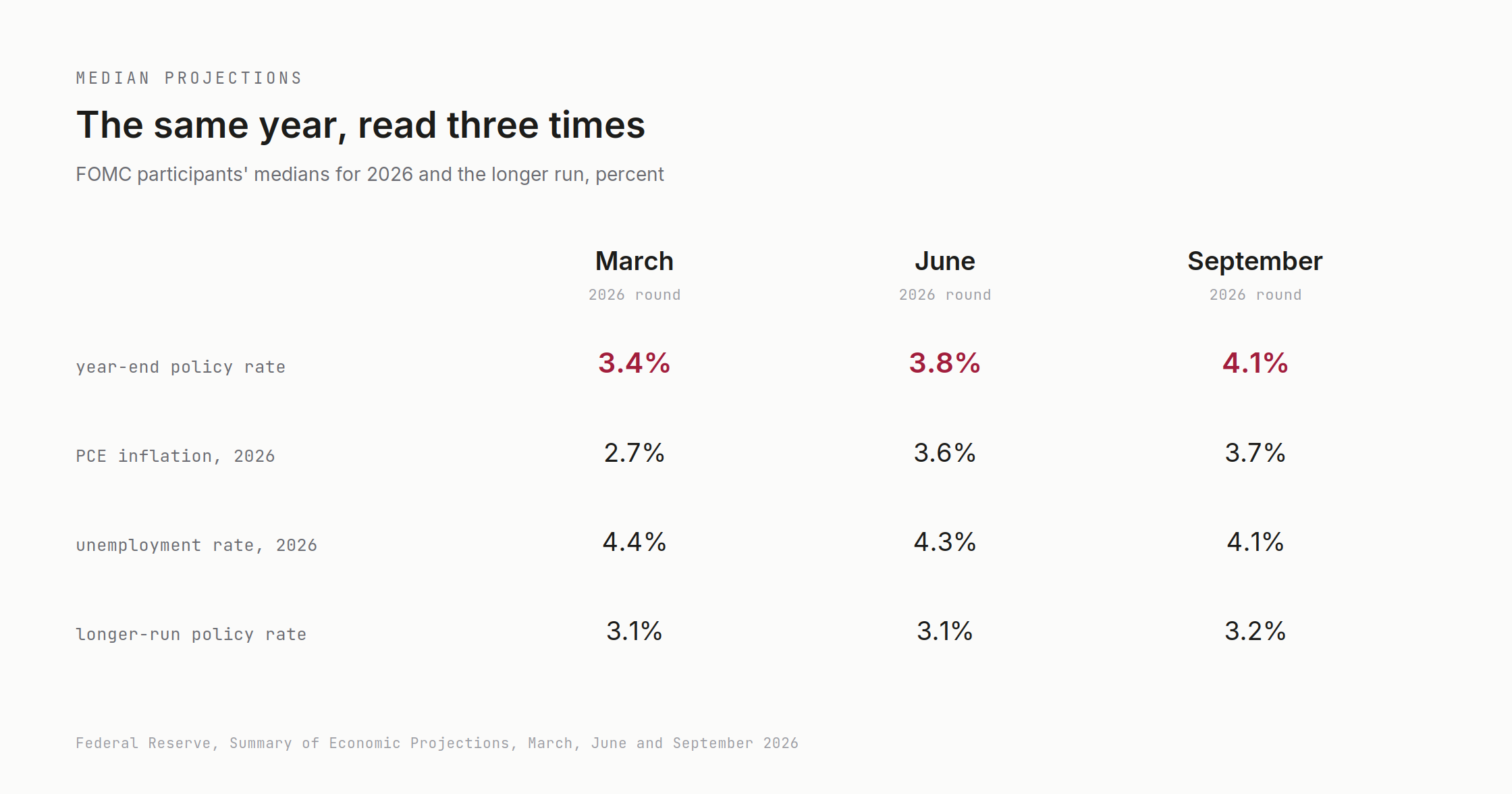
The Summary of Economic Projections published with the decision does supply a path. The median participant put the appropriate federal funds rate at 4.1% at the end of 2026 and at the same level at the end of 2027. Median PCE inflation was 3.7% for 2026 and 2.3% for 2027, with real GDP growth at 2.3% and unemployment at 4.1%. The arc of the year shows in the revisions. In March the median year-end policy rate was 3.4% against PCE inflation of 2.7%. By June the pair had moved to 3.8% and 3.6%, and in September to 4.1% and 3.7%. The chair submitted no projections in June or September, so the medians are the arithmetic of the eighteen participants who did.
The distribution inside the median
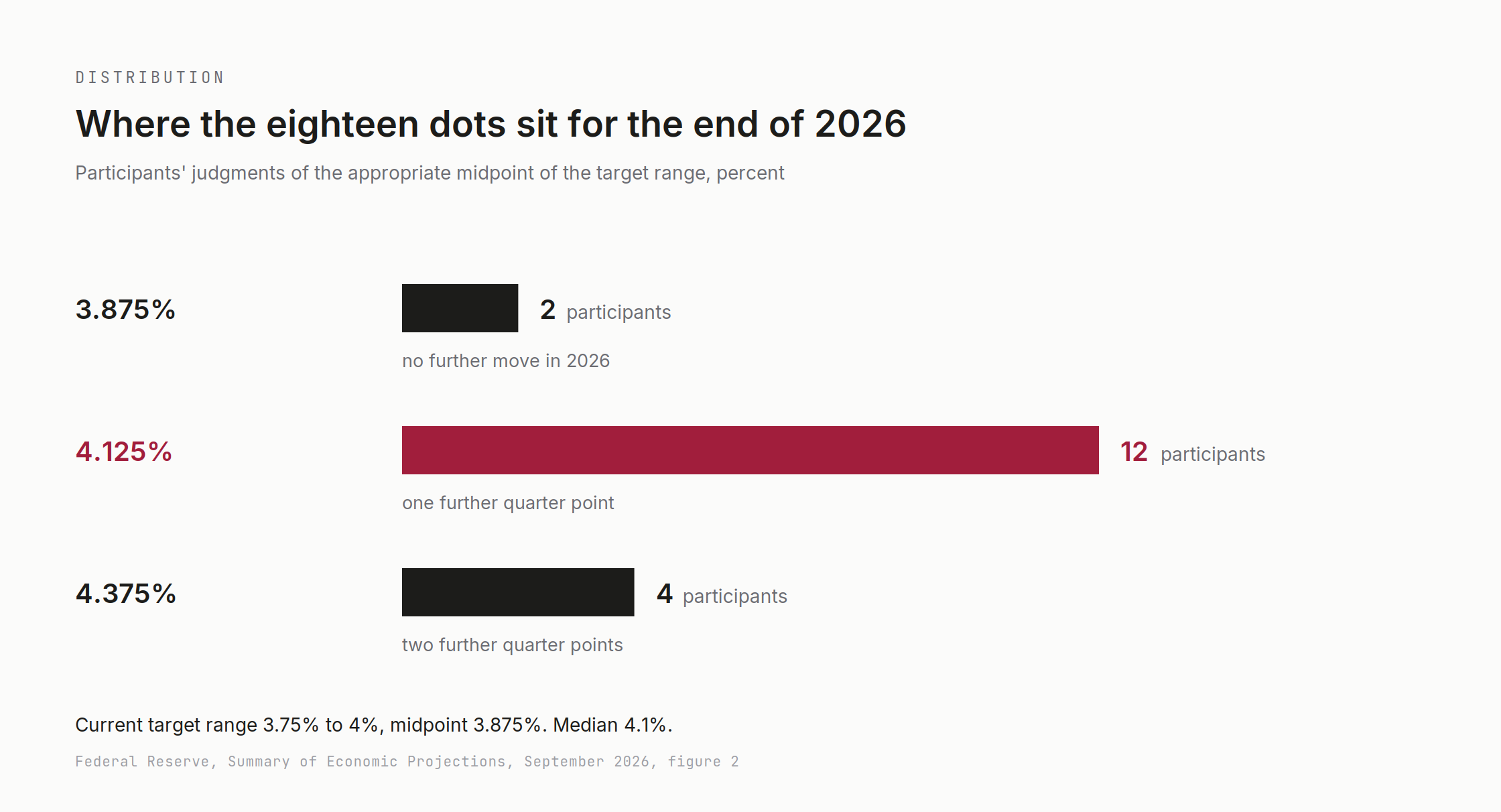
A median compresses a distribution that carries more than the median does. For the end of 2026, twelve participants placed the appropriate midpoint at 4.125%, which implies one further quarter point from the new range. Four placed it at 4.375%, implying two. Two placed it at 3.875%, implying no further move within the year. The risk assessments are more lopsided than the rate paths. Seventeen of eighteen participants weighted inflation risks to the upside, unchanged from June. On unemployment, seventeen recorded risks as broadly balanced, against seven weighting them to the upside three months earlier. The conditionality withheld at the podium sits in the document as a spread of individual judgments.
The benchmark still in the table
The neutral rate remains embedded in what the Committee publishes. The median longer-run federal funds rate rose to 3.2% from 3.1% in June, with the largest single cluster of participants at 3%. A policy rate of 4.1% at the end of 2026 therefore sits roughly nine tenths of a point above the median estimate of the level to which the rate converges. The concept declined as an operational input at the press conference continues to organise the far end of every participant's path, since a longer-run value is one of the entries each of them submits. The same table puts median PCE inflation at 2% in 2029, three years out from a meeting at which the action was described as supporting a timelier return to the goal.
What remains readable
When guidance is withdrawn the readable surface narrows to a few items. The wording of the standard comes first, since any change in how confidence, clarity and speed are described marks a change in the threshold. The projection revisions come second and the distribution behind each median third, because a cluster shifting a quarter point carries information a median can conceal. The risk boxes come fourth, where the balance between inflation and employment registers before it reaches the rate path. Unanimity comes fifth. A unanimous vote, following three dissents in favour of a rise at the previous meeting, reports a convergence the statement itself does not describe. None of these amounts to a schedule.