SHEIN, from the Buyer's Side to the Books
SHEIN listed in Hong Kong in 2026 at about a quarter of its 2022 peak. Its prospectus reads a familiar shopping app back into revenue per order, cost per order, and the distance between operating profit, net profit and cash.
From receipt to income statement
SHEIN reported net revenue of about 41.8 billion US dollars in 2025, on 1.08 billion orders and 273 million active customers. The size is real, and on its own it says little. A prospectus lets the app be read from the other side of the receipt: what a dress costs a customer becomes, for the company, revenue per order, product cost, warehousing and delivery cost, marketing cost, and whatever remains on the income statement. Read that way, the questions are where the revenue comes from, where the money goes, what becomes profit, and what becomes cash.
Growth into single digits
Revenue tells the size of the business, and its slope tells the stage. SHEIN's net revenue rose from about 32.1 billion dollars in 2023 to 38.7 billion in 2024 and 41.8 billion in 2025, but the growth rate fell from 41 percent to about 21 percent and then to 8 percent. In the first quarter of 2026 revenue rose about 1 percent, to 9.05 billion dollars, and the quarter swung to a net loss near 99 million dollars, from a profit of 395 million a year earlier. The company is still growing, and it no longer lifts revenue sharply each year through new markets and users.
Thirty-four orders a second
The operating base is large and fast. The 2025 orders work out to roughly 34 dispatched every second across the year. By mid-2026 SHEIN leased around 6 million square metres of warehouse space across Asia, North America, Europe, the Middle East and South America. It offered more than 2 million apparel styles, added on the order of 4,700 new styles a day under its first-party model, and drew on more than 7,500 contract manufacturers, most of them in China. Inventory turned in the mid-thirties of days, rising to 38 for the year to March 2026, which the prospectus attributes to shipping disruption around the Strait of Hormuz. A distant conflict lands as two days on one line of the accounts.
More orders, less on each
The order count and the revenue line move at different speeds. In 2025 active customers grew about 19 percent and orders about 17 percent, while revenue grew 8 percent. Dividing net revenue by orders gives roughly 45 dollars per order in 2023 and about 39 in 2025. This is not a strict basket size, because revenue includes platform service fees rather than the full price of third-party goods, but as a unit measure it is clear enough: more orders and more customers, and less revenue recognised on each order. More orders do not translate into revenue growing at the same pace.
From retailer to marketplace
The revenue base is broadening. Service revenue rose from 868 million dollars in 2023, or 2.7 percent of the total, to about 4.7 billion in 2025, or 11.3 percent, and reached 14.3 percent in the first quarter of 2026. Over the same span apparel fell from 68.8 percent of revenue to 63.8 percent, and to 61.4 percent in early 2026. Selling goods directly records product revenue; hosting third-party sellers records commissions, advertising and service fees. Both arrive through one app, and their accounting and their profit structure differ, so reading SHEIN means asking how much of the revenue is service, not only how many clothes it sells.
Where each $100 goes
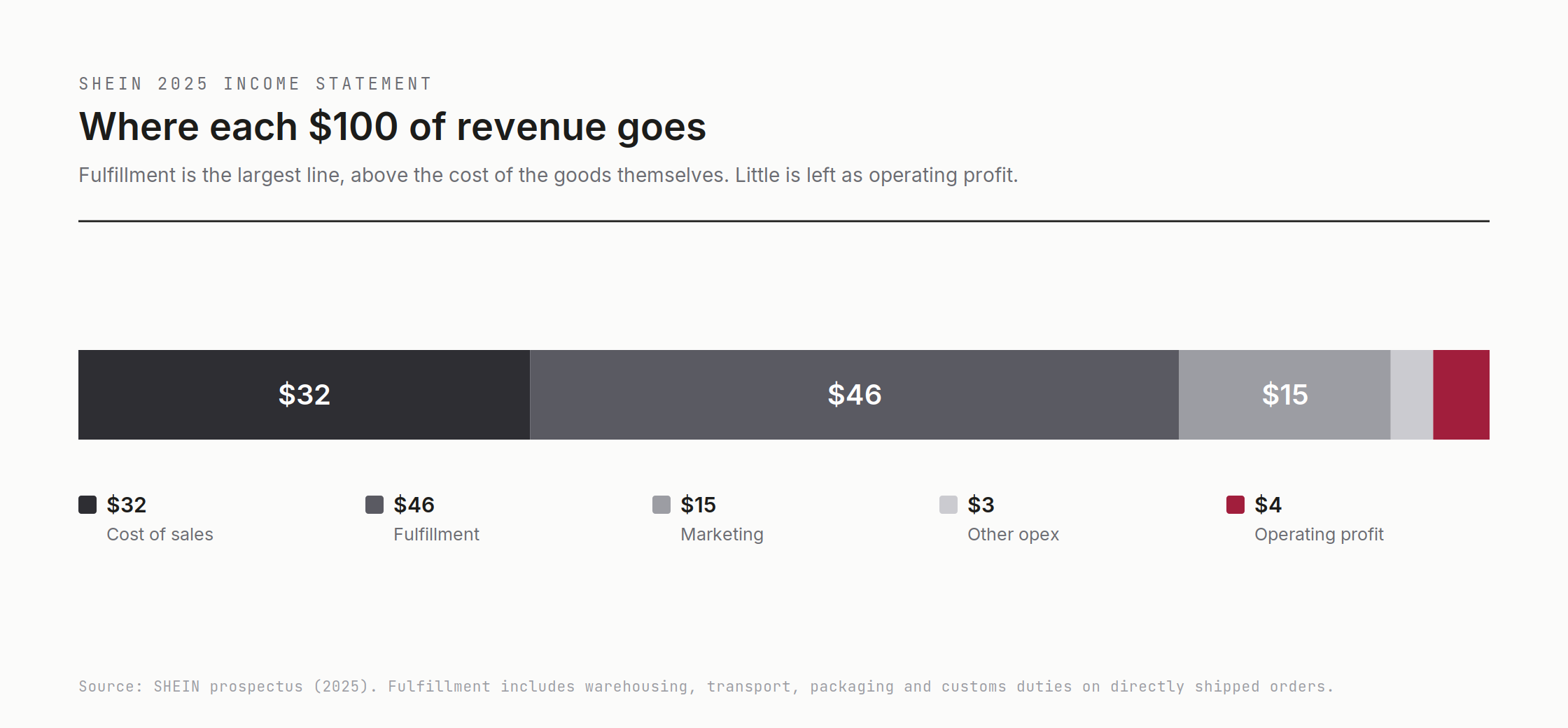
The income statement is easier to read as 100 dollars of revenue. In 2025 cost of sales took about 32 dollars, fulfillment about 46, and marketing about 15, leaving a few dollars to cover technology, content and administration and a thin operating margin. Fulfillment being larger than the cost of the goods surprises many readers. Per order it fell from 18.9 dollars in 2023 to 17.7 in 2025, and it is a composite of warehousing, sorting, packaging, transport and customs, not a per-garment shipping charge. One detail matters for what follows: when goods ship directly from SHEIN's warehouses to overseas customers, customs duties and tariffs are booked inside fulfillment expense.
When duty-free ends
Part of the low-price model rested on a rule that the accounts could not show. Low-value parcels long entered the United States duty-free under the de minimis exemption for shipments under 800 dollars. That exemption ended in 2025, and the European Union moved to a per-parcel fee on low-value imports. US revenue, once the largest source, fell about 14 percent in the first quarter of 2026, and Europe became the largest market at roughly a third of sales. Duties that once did not exist now sit inside the fulfillment line, so a thin per-order margin meets a new per-order cost. Marketing has climbed alongside: about 6.2 billion dollars in 2025, close to 15 percent of revenue and up from 11 percent, or roughly 5.74 dollars an order against 4.53 a year earlier.
Why net profit misreads the year
Net profit alone misreads the year. Operating profit rose from about 966 million dollars in 2024 to 1.7 billion in 2025, close to a 4 percent margin, so the operating business improved. Net profit moved the other way, from about 3.36 billion to 2.06 billion, a fall of roughly 39 percent, driven by the fair-value change on convertible redeemable preferred shares: a 2.4 billion gain in 2024 shrank to about 328 million in 2025, a non-cash swing of some 2.1 billion. Operating cash flow, meanwhile, rose from about 1.4 billion to 2.8 billion, and cash flow as a multiple of net profit went from 0.42 to 1.38. The operating result, the reported profit and the cash each tell a different part of the year, and they are worth reading apart.
What the listing settled
The listing put a number on all of it. SHEIN reached the Hong Kong exchange in 2026, after abandoned attempts in New York and London, at a valuation near 26.5 billion dollars, close to a quarter of the 100 billion it carried in private hands in 2022, and the shares eased on their debut. The prospectus arrives as growth flattens and the duty-free advantage is withdrawn, with the model's cushion thinner than at its peak. The revenue headline, on its own, settles little. The per-order economics, the shift toward services, the profit lines read separately, and the cash behind them all say more, and it is in those figures that the next chapters of the business will be decided.