The US-Japan Yen Intervention and the Bonds It Spared
The operation's lasting feature is the collateral arrangement behind it: Japan can defend the yen without selling the US Treasuries that anchor American long-term rates.
Why a solo intervention fades
A single authority selling dollars to buy its own currency faces a structural problem: the market knows the seller has finite reserves and a finite appetite for spending them. Intervention conducted alone tends to move the exchange rate for a session or two and then fade, because the underlying pressure, wide interest-rate differentials and steady capital outflows, is still there. Japan's finance ministry had spent much of 2026 buying yen on its own, including roughly ¥11.74 trillion across a stretch of late April and May by its own record, and the currency kept sliding toward levels last seen in the mid-1980s. Solo intervention rents time, and the rent comes due.
What made the 2026 operation different
The coordinated operation changed the arithmetic. Two sovereign balance sheets acted on the same target at the same time, the first occasion the United States and Japan had bought yen together since 1998. Market estimates put the size on the order of ¥14 trillion, about $88 billion, across two sessions, pending the ministry's official figures, and the operation was reported to have run partly through the euro-yen cross rather than directly through dollar-yen. It rested on a documented basis: a joint statement issued by the two finance ministries in September 2025. When two states spend increasingly scarce reserves on one currency in concert, a defended level becomes harder to fade.
The collateral problem
Coordination raises a question of funding. To buy yen an authority needs dollars, and the classic way for Japan to raise them is to sell US Treasuries out of its reserves. Doing that at scale pushes Treasury prices down and yields up, which works against the United States when its long-term borrowing costs are already climbing; the ten-year Treasury yield rose through 2026 from about 4.1 percent to about 4.6 percent. A currency defense financed by selling Treasuries would prop up the yen while unsettling the US bond market. That is the tension the 2026 operation was built to avoid.
How the repo facility resolves it
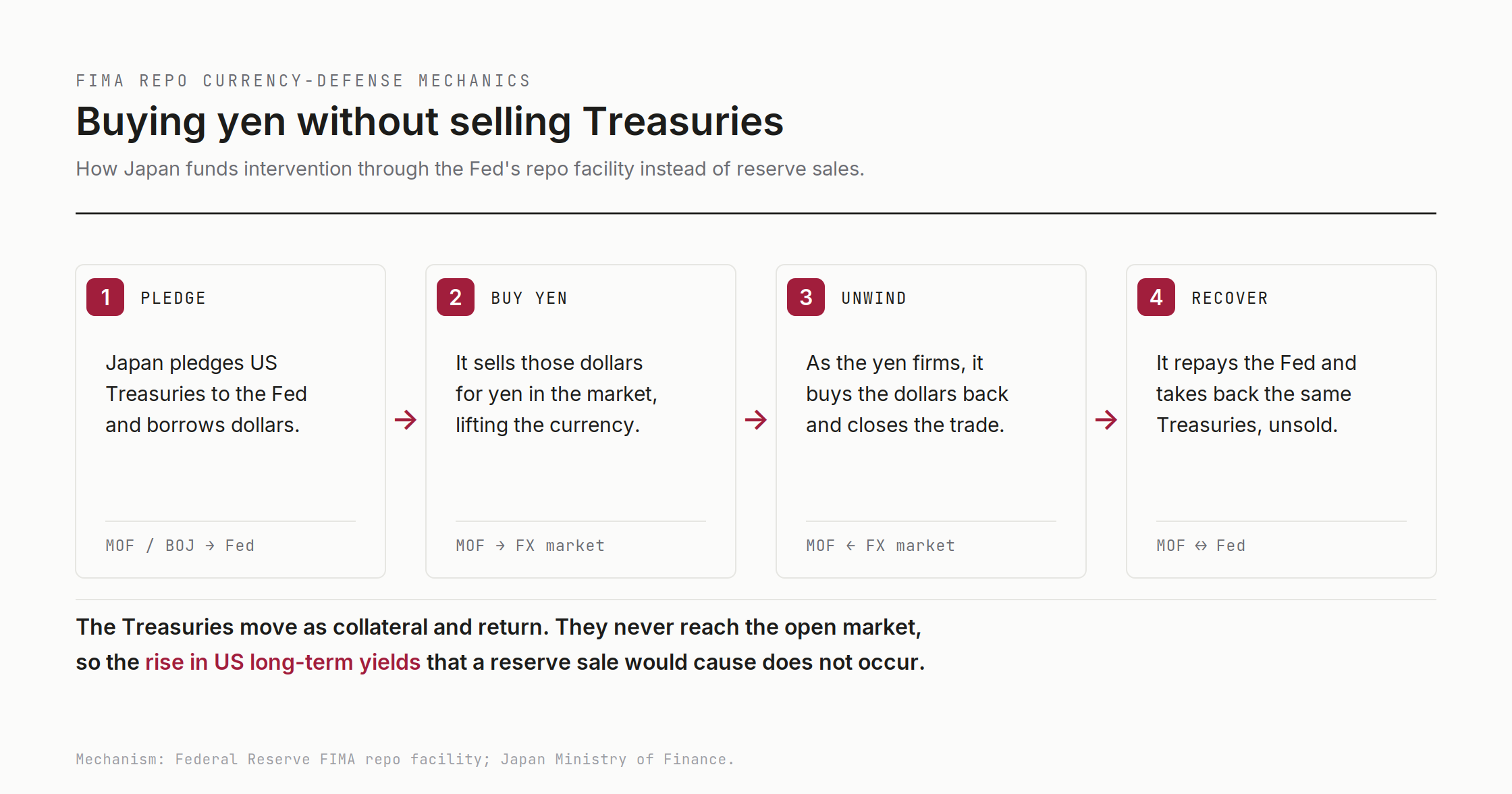
The resolution runs through a Federal Reserve facility introduced in 2020, the Foreign and International Monetary Authorities repo facility, which lets an eligible foreign authority raise dollars against its Treasury holdings rather than by selling them. The chain is short: Japan pledges Treasuries to the Fed and borrows dollars, sells those dollars for yen in the market, and later unwinds the trade and recovers the collateral. The Treasuries never reach the open market, so the yield pressure a reserve sale would create does not occur. Japan's finance ministry has said it intends to fund future intervention this way, and the US Treasury has pressed for the facility to be enlarged, which would require the Federal Reserve's agreement.
The signal and the trade
Seen this way, the operation's most durable element is a signal more than a sum. Buying ¥14 trillion moves the rate for a while; demonstrating that Japan can keep buying, funded by a standing dollar facility and joined by the US Treasury, changes what a speculator can assume about how far and how long the level will be held. The deterrent works to the extent the commitment is credible, and that credibility now rests partly on continued access to the facility and on the coordination between the two governments.
What the arrangement also protects
The arrangement reaches past the yen. Keeping Japan's reserves off the market shields US long-term rates from a forced seller, and steadying the yen lessens the pull on other Asian currencies that a sharp move can set off. A weak yen also feeds back into Japan's own bond market, where higher yields raise the cost of a large public debt, so a firmer yen eases that channel too. One operation therefore touches the currency, the US Treasury market, regional exchange rates, and Japanese government funding at the same time.
What is left to the reader
What the arrangement cannot remove is its own conditionality. A currency defense that draws its strength from a foreign central bank's facility and a partner treasury's participation is only as durable as both. Access to the repo facility can be sized or limited by the institution that runs it, and the coordination can shift with the politics of either capital. Whether an intervention built on shared plumbing is steadier than one a country runs alone, or simply more exposed to a second set of decisions it does not control, is a question the next episode of yen weakness will test.