Four Pressures Behind Hong Kong Tech's 40% Decline
The Hang Seng TECH Index slipped below 4,000 in October, roughly 40% below its peak a year earlier. The decline coincided with a surge in Hong Kong fundraising, slower inflows, changes to the index methodology and pressure on valuation multiples. The connection between these developments lies in how investors allocate capital and how prices are set at the margin.
A year-long decline
The Hang Seng TECH Index fell below 4,000 in October, reaching its lowest level since October 2024. It had lost about 8% in September and a further 6% or so during October. From a peak near 6,700 in October 2025, the decline amounts to roughly 40% over the course of a year. That reversal stands in sharp contrast to the index's 23.5% gain during 2025. The broader Hang Seng Index fell much less over the same period, suggesting that the weakness was particularly pronounced among technology shares. Understanding that divergence requires looking at four related forces: new share supply, investor flows, index construction and valuation.
A fundraising boom alongside falling share prices
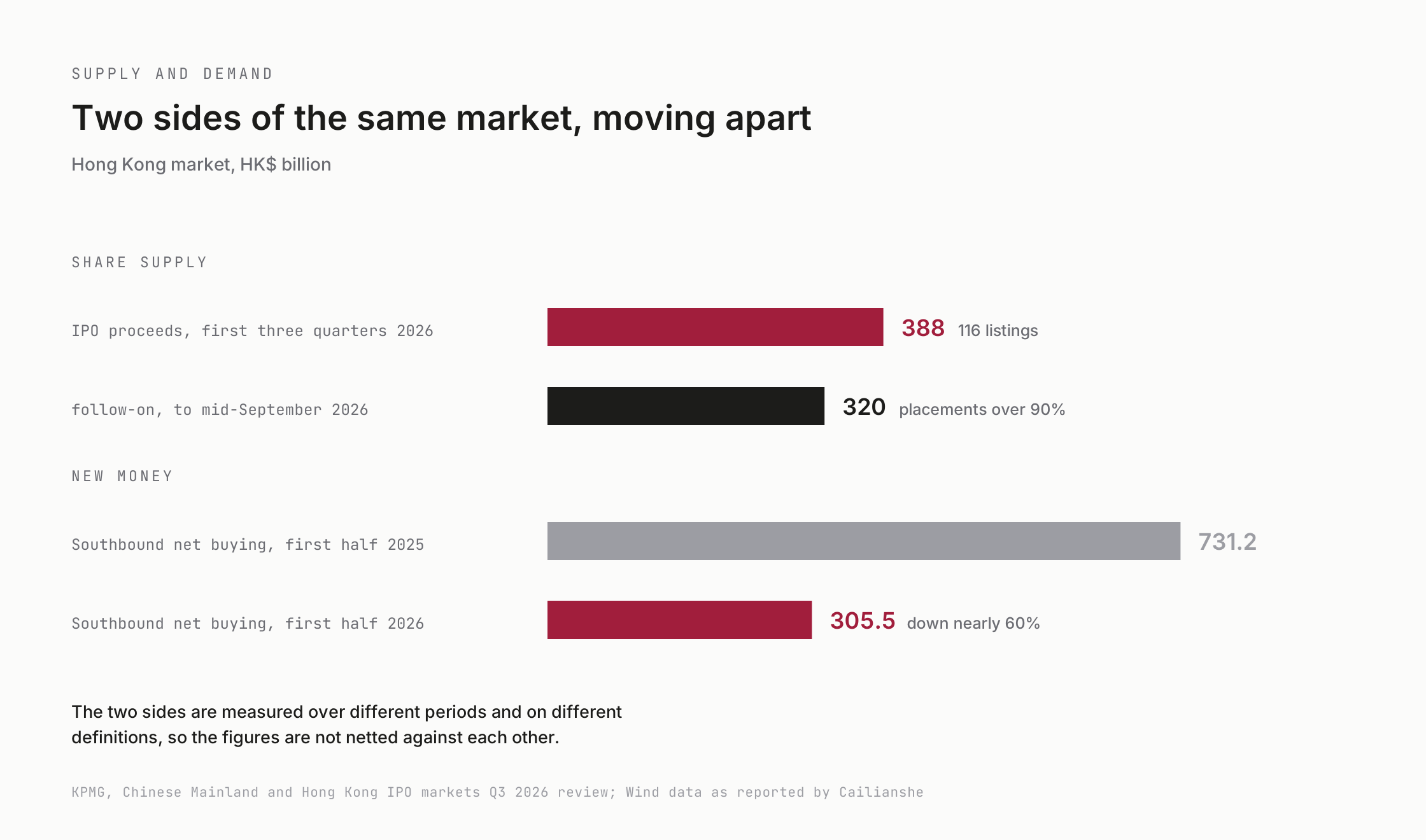
Hong Kong's primary market remained active throughout the decline. According to KPMG, 116 companies listed in the first three quarters of 2026, raising approximately HK$388 billion. Proceeds more than doubled from a year earlier and exceeded the total for all of 2025. KPMG expected full-year fundraising to approach HK$500 billion, potentially surpassing the 2010 record of about HK$449.5 billion.
It is tempting to conclude that money raised by new listings must have been taken directly out of existing shares. The relationship is more complicated. IPO investors transfer funds to issuers, which can then use the proceeds for investment, operations or debt repayment. Secondary-market transactions, meanwhile, transfer cash and shares between investors. Neither flow, by itself, tells us how much buying demand has disappeared from listed stocks. The relevant question is how investors finance their subscriptions and adjust their portfolios in response.
The constraint inside an investment portfolio
Consider an equity fund operating within a defined investment mandate, sector limits and risk budget. Its cash allocation is already close to the minimum permitted level when an attractive technology company announces a Hong Kong listing. The manager wants to subscribe, but must first decide where the money will come from.
The fund could use its remaining cash, receive fresh subscriptions or sell part of its existing portfolio. Each choice has different consequences. If new money arrives, the fund can add the IPO without reducing other holdings. If its allocation budget is fixed and cash is scarce, the manager may need to sell something to make room. Liquid, sizeable positions are often easier to reduce quickly, which can bring large index constituents into the rebalancing process. This is one way an active primary market can influence prices in the secondary market, even without a direct one-for-one transfer of funds.
Three channels of additional share supply
New share supply reached the market through several channels. IPOs raised approximately HK$388 billion in the first three quarters. Of the 116 listings, 38 were A+H offerings, accounting for close to 70% of proceeds. Another 19 companies listed under Chapter 18C, the specialist technology regime, raising around HK$36.2 billion.
Existing listed companies also sought capital. Wind data put follow-on fundraising above HK$320 billion by mid-September, excluding convertible bonds, with placements accounting for more than 90% of that figure. Placements often price new shares at a discount to the prevailing market price, creating a new reference point for investors and potentially prompting portfolio adjustments. A further source of potential supply is the expiry of lock-up periods. As restrictions on some shares issued earlier in the year come to an end, more holders become eligible to sell. What changes at expiry is the market's assessment of future supply rather than the number of shares actually sold.
Inflows slowed, and allocations shifted
At the same time, an important source of demand grew more slowly. Southbound net buying totalled approximately HK$305.5 billion in the first half of 2026, compared with about HK$731.2 billion a year earlier, a decline of nearly 60%. The allocation of that money also changed. Reported flows included sales of roughly 265 million Alibaba shares, worth about HK$36 billion, alongside greater interest in semiconductors, electronic materials and high-dividend banks.
Over several weeks in September, active global funds also recorded outflows from Hong Kong equities, with internet shares among the more heavily affected sectors. Separately, measures introduced in May against illegal cross-border securities business led some offshore brokers to restrict purchases and new deposits by certain Mainland clients while continuing to permit sales and withdrawals. The scale of any resulting impact on the index remains difficult to establish from public data. Taken together, these developments point to a shift in the amount and direction of marginal buying demand, rather than a simple absence of capital from the market.
Index rules can reshape demand
Index construction adds another layer. The Hang Seng TECH Index applies an 8% cap to the weight of any single constituent at scheduled rebalancing points. Several major internet companies carry substantial weights, so their share-price movements can have a disproportionate influence on the index. At the same time, changes in membership can introduce new sources of volatility. Two newly listed large-model companies entered the index in June and subsequently fell by approximately 46% and 39%, respectively, in September.
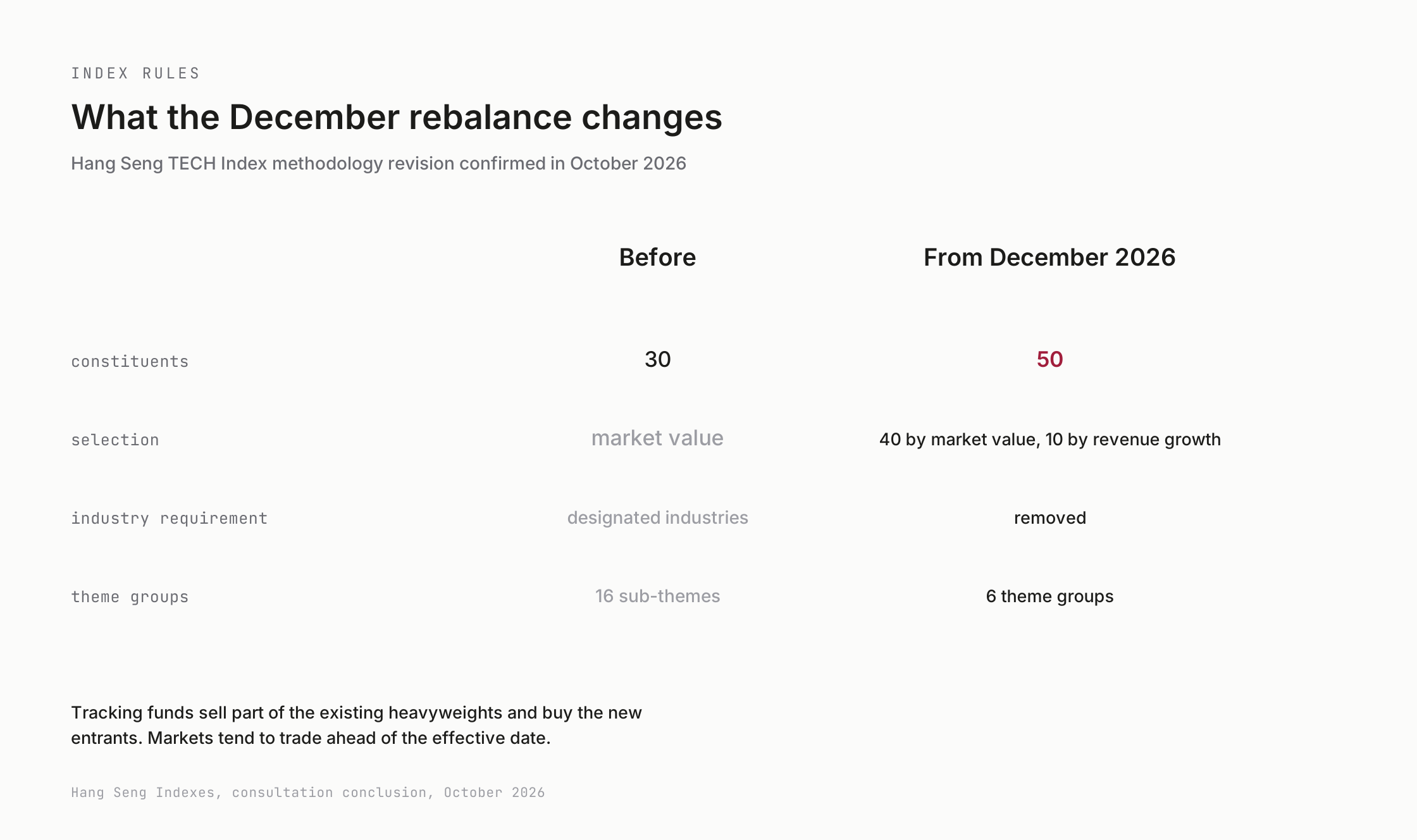
The methodology itself was also under review. In August, Hang Seng Indexes proposed expanding the index from 30 to 50 constituents. The change was confirmed in October, with the new composition scheduled to take effect at the December rebalance. Adding members changes the relative weights of existing stocks and creates buying demand for new entrants among index-tracking funds. The direction and size of trades depend on the final weights, the funds' holdings and the assets tracking the index. Investors may also anticipate these adjustments before they take effect. Index reform can therefore influence trading patterns even while its broader purpose is to improve market representation.
When earnings and valuations move apart
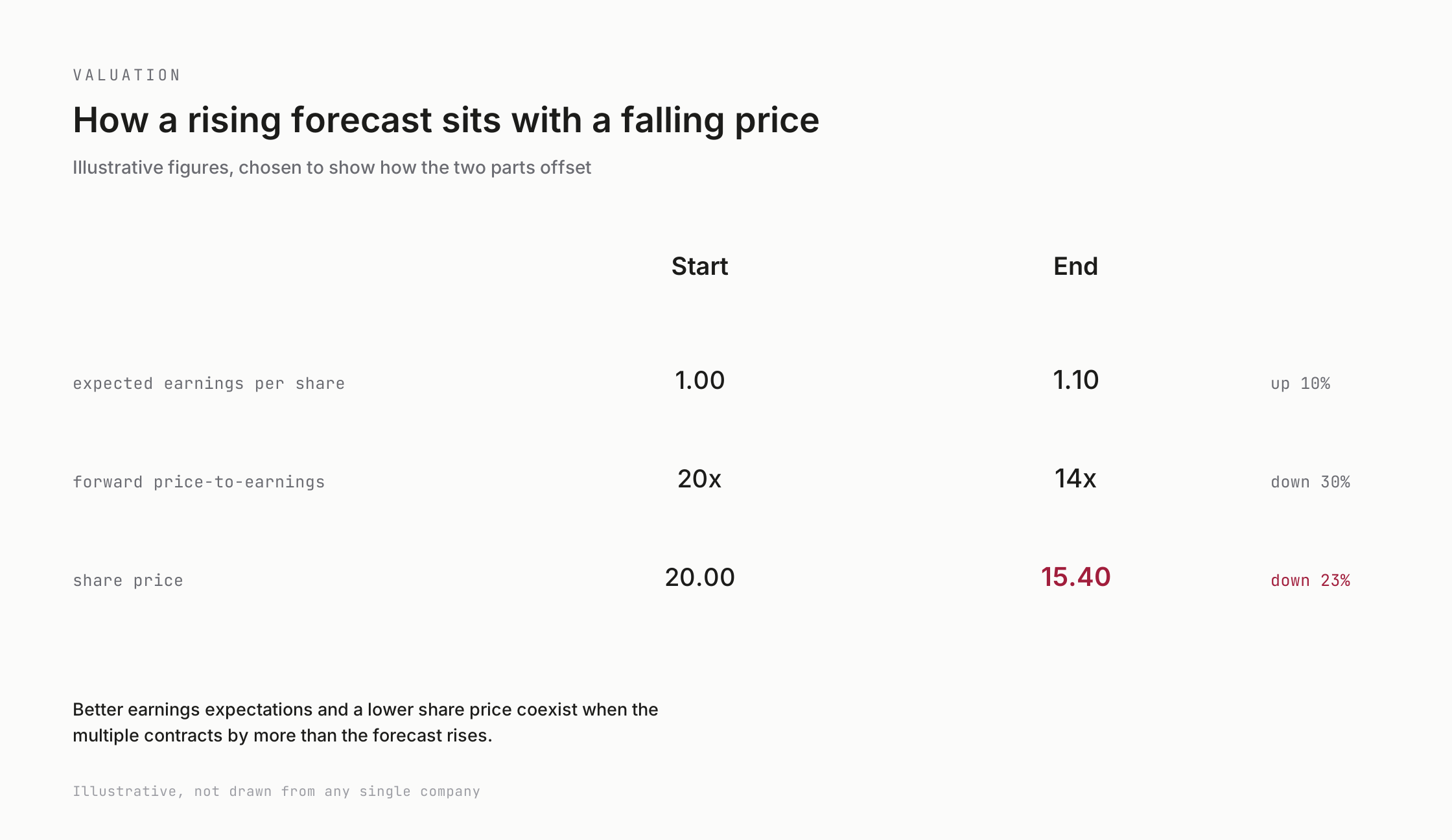
Share prices also reflect changes in what investors are willing to pay for future profits. For a company with positive, reasonably stable earnings, the share price can be expressed as expected earnings per share multiplied by the forward price-to-earnings ratio. The two components need not move in the same direction. If expected earnings rise by 10% while the multiple falls from 20 to 14, the implied share price declines by 23%.
This distinction matters when assessing technology shares. Major platforms have increased spending on artificial intelligence, raising questions about the timing of future cash returns. Tencent, for example, reported second-quarter capital expenditure of around RMB 52.8 billion, up approximately 176%, and free cash flow of roughly negative RMB 13.8 billion. Such figures need to be read in the context of the investment cycle and the company's own cash-flow definitions. Interest rates matter as well: longer-dated cash flows become less valuable when the discount rate rises, although the relationship between US Treasury yields, Hong Kong dollar rates and equity valuations is not mechanical. The index traded at approximately 21 times trailing earnings in October. A low multiple alone, however, does not establish how much of the decline was caused by changing earnings expectations rather than repricing.
What the sequence tells us
The timing helps distinguish possible contributors from explanations that cannot account for the start of the decline. Measures addressing illegal cross-border securities activity were introduced in May. Two large-model companies entered the index in June. The index-expansion consultation followed in August. September brought reported changes in brokerage access, active-fund outflows and sharp declines in some newer constituents. The methodology decision and a separate regulatory circular on sponsor work arrived in October. Later events may have affected sentiment or trading, but they cannot explain price declines that had already occurred.
The relative importance of these forces remains an empirical question. Four sets of evidence would help answer it: monthly IPO and placement proceeds alongside lock-up expiries; Southbound and international fund flows by sector; each constituent's contribution to index returns; and changes in earnings forecasts and valuation multiples for the largest holdings. Aligning these series over comparable periods would provide a firmer basis for separating coincidence from causation.
The December index rebalance offers the next observable test of the methodology changes. More broadly, this episode illustrates how an expanding equity market can experience strong fundraising activity and weak index performance at the same time. The outcome depends on how new securities are absorbed, how investors redistribute their portfolios and how future earnings are valued.